Types of cross stitch fabric and how to choose
· 8 min read
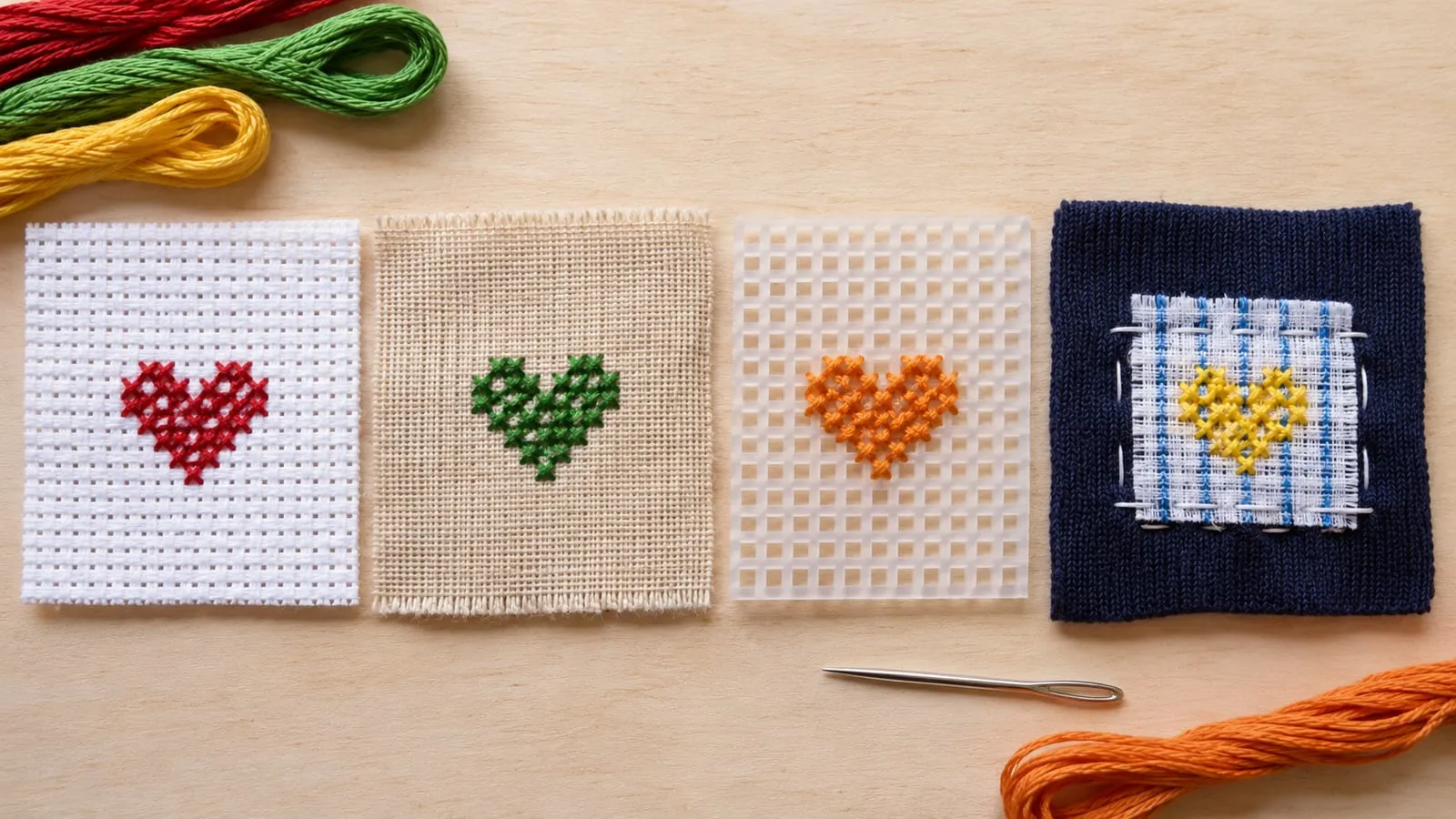
Cross stitch needs a counted fabric, one with even rows of blocks or threads you can count. The easiest to start on is 14 count Aida. Evenweave and linen are for fine work, plastic canvas for 3D pieces, and waste canvas or water-soluble canvas let you stitch on clothes and towels.
In short
- Aida is a cotton fabric of blocks with holes; each stitch goes over one block. It’s the best choice for a first project.
- Evenweave and linen are woven from single threads and you stitch over 2 of them, so 28 threads per inch give the same stitch size as Aida 14.
- Plastic canvas is stiff and needs no hoop. It’s used for boxes, bookmarks and toys.
- Waste canvas is basted onto clothing and pulled out thread by thread after stitching; water-soluble canvas dissolves in warm water.
- Stramin is a rare stiff mesh for tapestry and rugs. For floss, take Aida instead.
What is cross stitch fabric called?
In English it’s simply cross stitch fabric or counted cross stitch fabric, and the most common kind is Aida cloth. Other languages name it differently, and one word can mean different fabrics:
| Language | What Aida is called | General word for counted fabric | Watch out for |
|---|---|---|---|
| English | Aida cloth | cross stitch fabric | count: the number of blocks per inch |
| German | Aida-Stoff | Zählstoff | Stramin is a coarse canvas for tapestry, not Aida |
| Polish | kanwa Aida | kanwa | kanwa is any base fabric for embroidery |
| Spanish | tela Aida | tela para punto de cruz | etamina in Spain is an evenweave like Lugana |
| Portuguese (Brazil) | etamine | tecido para ponto cruz | etamine in Brazil is Aida itself |
| Ukrainian | канва Аїда | канва | рівномірка is evenweave; домоткане полотно (homespun cloth) is for traditional embroidery |
So when you buy fabric from a shop abroad or stitch from a pattern in another language, check the number of blocks or threads per centimeter, not the name.
What types of cross stitch fabric are there?
| Fabric | How it’s woven | Fiber | Usual counts | Used for |
|---|---|---|---|---|
| Aida | blocks with a hole at each corner | cotton | 11, 14, 16, 18 | almost any cross stitch, first projects |
| Large Aida (Binca, Hertha) | the same, blocks about 4 mm | cotton | 6 | stitching with children, learning |
| Evenweave (Lugana, Brittney, Murano) | an even weave of single threads | cotton and modal | 25, 28, 32 | fine work, quarter stitches |
| Linen (Cashel, Belfast, Edinburgh) | single threads, with occasional slubs | 100% linen | 28, 32, 36 and up | heirloom and special-occasion pieces |
| Hardanger | paired threads in an even grid | cotton | 22 | Hardanger embroidery, cross stitch over 2 |
| Plastic canvas | a stiff plastic grid | plastic | 7, 10, 14 | boxes, bookmarks, 3D pieces |
| Waste canvas | an open mesh you remove after stitching | cotton with sizing | various | stitching on clothes, towels, bags |
| Water-soluble canvas | a mesh that dissolves in water | polyvinyl alcohol | 14, 16 | the same, on small items |
The fibers and counts come from the Zweigart catalog and DMC’s product descriptions. Cross stitch fabric sizes are given as a count, and everywhere it means blocks or threads per inch (2.54 cm).
Aida vs evenweave vs linen: what’s the difference?
Aida is woven in blocks: each block is one stitch, the holes are easy to see and counting is simple. Evenweave and linen are woven from single threads, and a cross stitch usually goes over 2 threads each way. So they give half as many stitches per inch as they have threads:
| Fabric | Threads or blocks per inch (per cm) | Stitches per inch (per cm) | Same stitch size as |
|---|---|---|---|
| Aida 14 | 14 (5.5) | 14 (5.5) | Aida 14 |
| Evenweave 25 | 25 (10) | 12.5 (5) | Aida 12.5 |
| Evenweave 28 | 28 (11) | 14 (5.5) | Aida 14 |
| Linen 32 | 32 (12.6) | 16 (6.3) | Aida 16 |
| Linen 36 | 36 (14.2) | 18 (7.1) | Aida 18 |
The counts are nominal. Zweigart’s Cashel linen 28 has 11.0 threads per centimeter, and Brittney evenweave 28 has 11.2. On a pattern 300 stitches wide, that’s a difference of almost 0.4 in (1 cm).
Here is what each one is chosen for:
- Aida is the easiest: you can see the blocks, and the fabric is firm and holds its shape. Quarter stitches are awkward, though, because you have to pierce the middle of a block.
- Evenweave is softer and more even. It has a hole in the middle of every stitch, so quarter stitches and fine details sit neatly. Lugana, Brittney and Murano are cotton with modal, not linen, and cost less than linen.
- Linen is the most expensive and the fussiest. Its threads vary in thickness and have slubs, which makes them harder to count. People choose it for its texture when the background is left unstitched.
- Hardanger (22 threads per inch) stitched over 2 gives the same stitch size as Aida 11. In Germany, Zweigart sells it as Sulta.
Which fabric should a beginner start with?
Cotton Aida 14, in white or cream. Its blocks, about 1.8 mm across, are visible without a magnifier, you don’t have to count threads, and nearly all patterns and kits are made for it. DMC also recommends Aida 14 for beginners. How Aida 11, 14, 16 and 18 change the size of the finished piece is covered in Aida cloth sizes: which count to choose for cross stitch. For children, try large Aida 6 or plastic canvas: the stitch on them is several times bigger.
Move on to evenweave once counting blocks feels easy and you want finer work or quarter stitches. Start with evenweave 28: its stitch is the same size as on Aida 14.
The needle size and number of strands for each of these fabrics are in What size needle for cross stitch? Needle and strands chart.
What is plastic canvas used for?
Plastic canvas is a stiff plastic grid. It needs no hoop, it holds its shape, and you can sew several pieces together into a 3D item: a box, a tissue box cover, a toy, a magnet or a bookmark. It comes in different meshes:
- 7 and 10 holes per inch are for thick wool or acrylic yarn; the stitch is large and works well for children.
- 14 holes per inch is for floss; the stitch is the same as on Aida 14, so a regular cross stitch pattern works on it without any conversion.
If you want to stitch a regular DMC floss pattern on plastic canvas, take 14 count: on 7 and 10 count, floss won’t cover the grid.
How do you cross stitch on a T-shirt or towel?
With waste canvas or water-soluble canvas. Knit fabric, denim and terry cloth have no blocks, so you baste a mesh on top, stitch through both layers, and remove the mesh afterwards.
| What to compare | Waste canvas | Water-soluble canvas |
|---|---|---|
| Made of | cotton threads held together by sizing | polyvinyl alcohol |
| How to remove | dampen it and pull the threads out with tweezers | soak in warm water, 104–122 °F (40–50 °C), until it dissolves |
| Sheet size | large sheets and rolls | small sheets; DMC’s is about 8 × 8.7 in (20 × 22 cm) |
| Watch out for | pull the threads along the fabric, not upward | the fabric and floss must be colorfast; iron only afterwards |
The steps are the same for both:
- Cut a piece of canvas a couple of inches larger than the design on every side.
- Baste it to the item with large stitches so it doesn’t shift.
- Stitch through both layers, following the blocks of the canvas.
- Trim the extra canvas around the edges, leaving a little next to the stitching.
- Dampen it and pull out the threads one at a time, or dissolve the canvas in warm water.
DMC describes waste canvas as a cotton mesh held by water-soluble sizing: once it’s damp, the threads slide out easily. DMC’s water-soluble canvas has 14 blocks per inch and dissolves at 104–122 °F (40–50 °C), so the item and the floss have to survive a wash at that temperature.
What is Stramin, and can you cross stitch on it?
Stramin is a stiff, open cotton canvas for tapestry, half cross stitch and rugs. Zweigart makes it from 3 to 18 threads per inch. You can cross stitch on it, but usually with thick wool: 2 strands of floss won’t cover the coarse mesh, and the base will show through the stitches. For a regular pattern in DMC floss, take Aida or evenweave. The German word Stramin is sometimes used for waste canvas too (Abreißstramin), so read the description in the shop.
Try it
Upload a picture to the editor, choose Aida 11, 14, 16 or 18 in the “Fabric” section and check the size of the finished piece. If you’ll be stitching on evenweave or linen, enter the pattern size into the cross stitch calculator: it converts it for fabrics from 25 to 40 count stitched over 2 and shows the fabric to cut, the needle and the number of strands.
Try it with your own photo
Upload a photo — a pattern with DMC thread numbers is ready in a second.
Open the editorNew lessons by email
Now and then we send new lessons, ideas and patterns. No spam, unsubscribe at any time.