Cross stitch vs embroidery: what's the difference?
· 9 min read
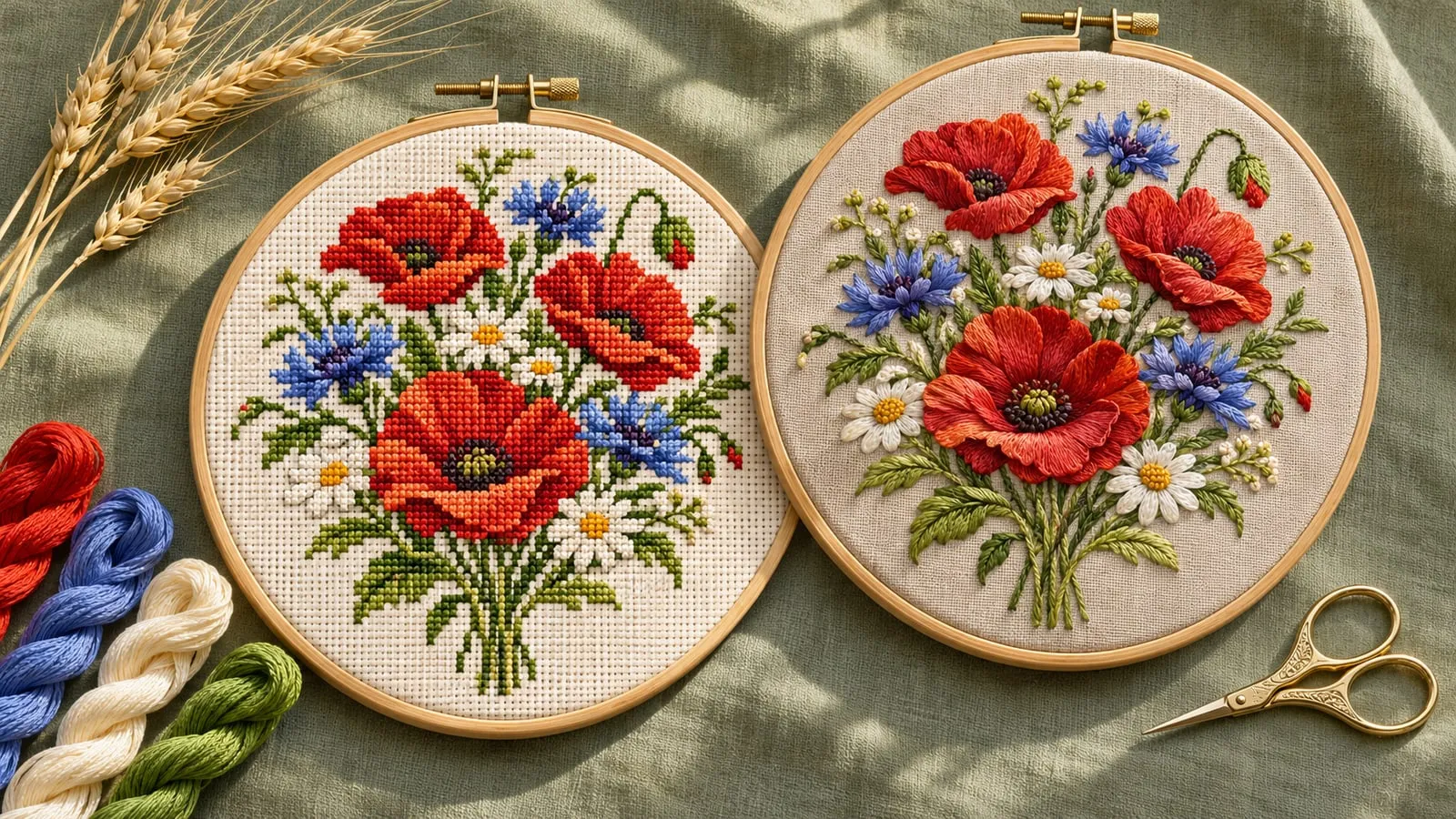
Yes, cross stitch is embroidery. Embroidery just comes in many forms, and cross stitch is the most disciplined member of the family: identical Xs sit on the squares of the fabric and add up to a picture, like pixels on a screen. When people ask whether to pick “cross stitch or embroidery”, they almost always mean surface embroidery, where the design is drawn right on the fabric and the stitches go wherever you like.
And they feel like different hobbies. Cross stitch is a bit like a crossword: you count squares, check the chart, place the next X. Surface embroidery is closer to drawing, except your pencil is a thread and lines are harder to erase.
Is cross stitch the same as embroidery?
Cross stitch is a type of embroidery. Embroidery covers anything made on fabric with needle and thread: free surface work, machine embroidery and counted techniques, where each stitch is tied to the threads of the fabric. Cross stitch is one of the counted ones, alongside blackwork, Hardanger and needlepoint. Every cross-stitch piece is embroidery, but plenty of embroidery has no Xs in it.
You don’t always count, by the way. Stamped kits have the design printed on the fabric, and you just cover the colored marks with the same Xs. From here on we mean regular counted cross stitch from a chart, done by hand.
What’s the difference between cross stitch and embroidery?
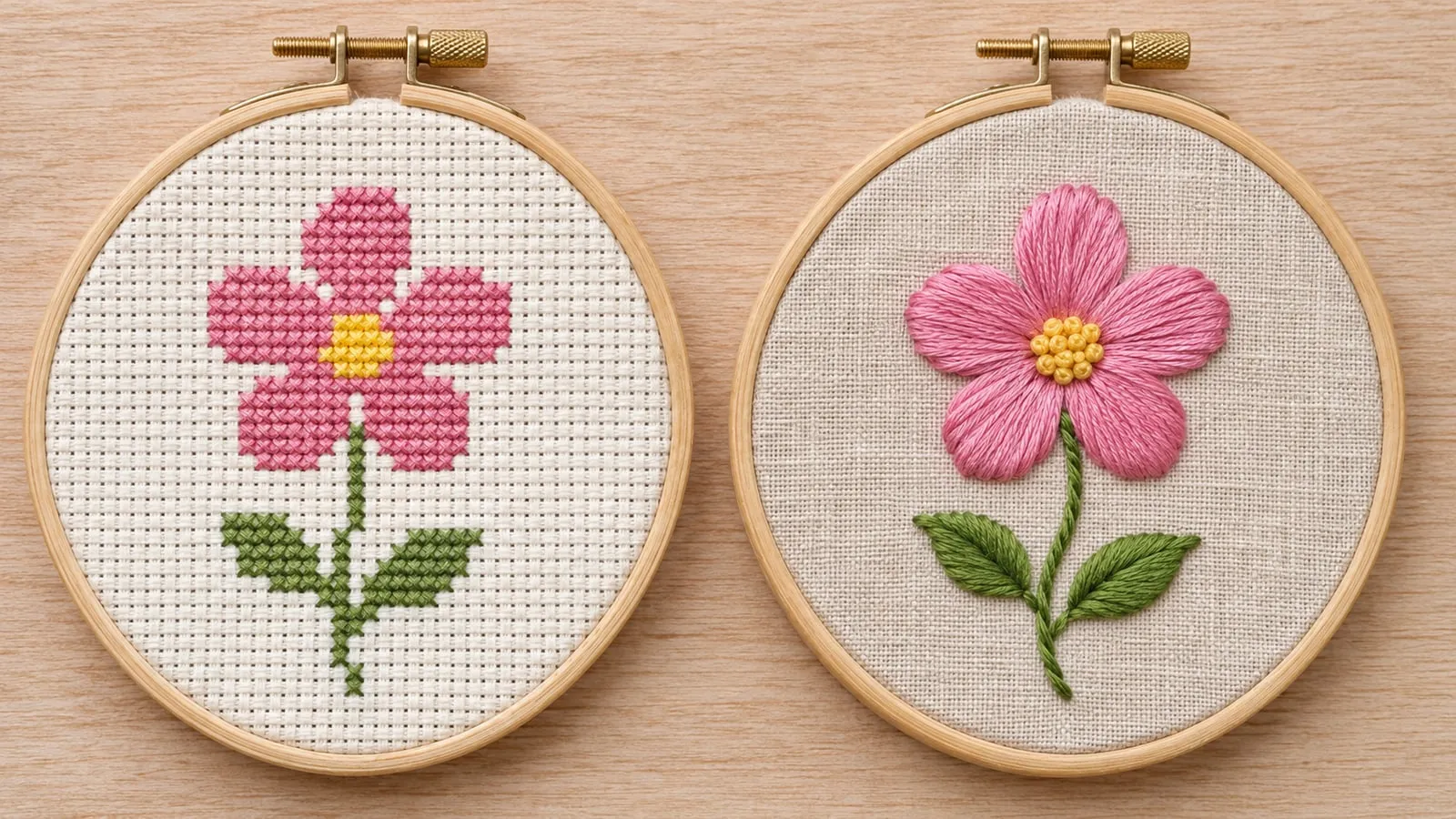
In cross stitch, the grid of the fabric dictates the shape. A stitch takes up exactly one square, so a circle comes out stepped however careful you are: look at the left flower in the photo. In surface embroidery the needle goes in any direction and a stitch can be any length, so lines are smooth and the surface can be sleek, raised or covered in knots.
| Compare | Cross stitch | Surface embroidery |
|---|---|---|
| What sets the shape | the squares of the fabric | the lines of the design on the fabric |
| Where the design is | on a chart, one square is one X | transferred onto the fabric |
| Fabric | Aida, evenweave, linen | tightly woven cotton, linen, silk |
| Needle | blunt tapestry needle, size 22–26 | sharp embroidery needle, roughly size 5–10 |
| Stitches | the cross, its partial forms, backstitch, knots | dozens: satin, stem, chain and more |
| Thread | floss, usually 2 strands on Aida 14 | floss in 1 to 6 strands, pearl cotton, wool |
| Hoop | optional on stiff Aida | nearly always needed |
| Look | an even mosaic of identical Xs | lines, texture, the sheen of long stitches |
How many stitches do you have to learn?
For cross stitch, one: two diagonals, and that’s enough for a whole picture. Later you’ll pick up half, quarter and three-quarter stitches for small details, backstitch for outlines and French knots for dots, but those come along as you go. Surface embroidery has dozens of stitches, and hundreds if you count all the variations. Don’t let that scare you: five or six are plenty for your first projects.
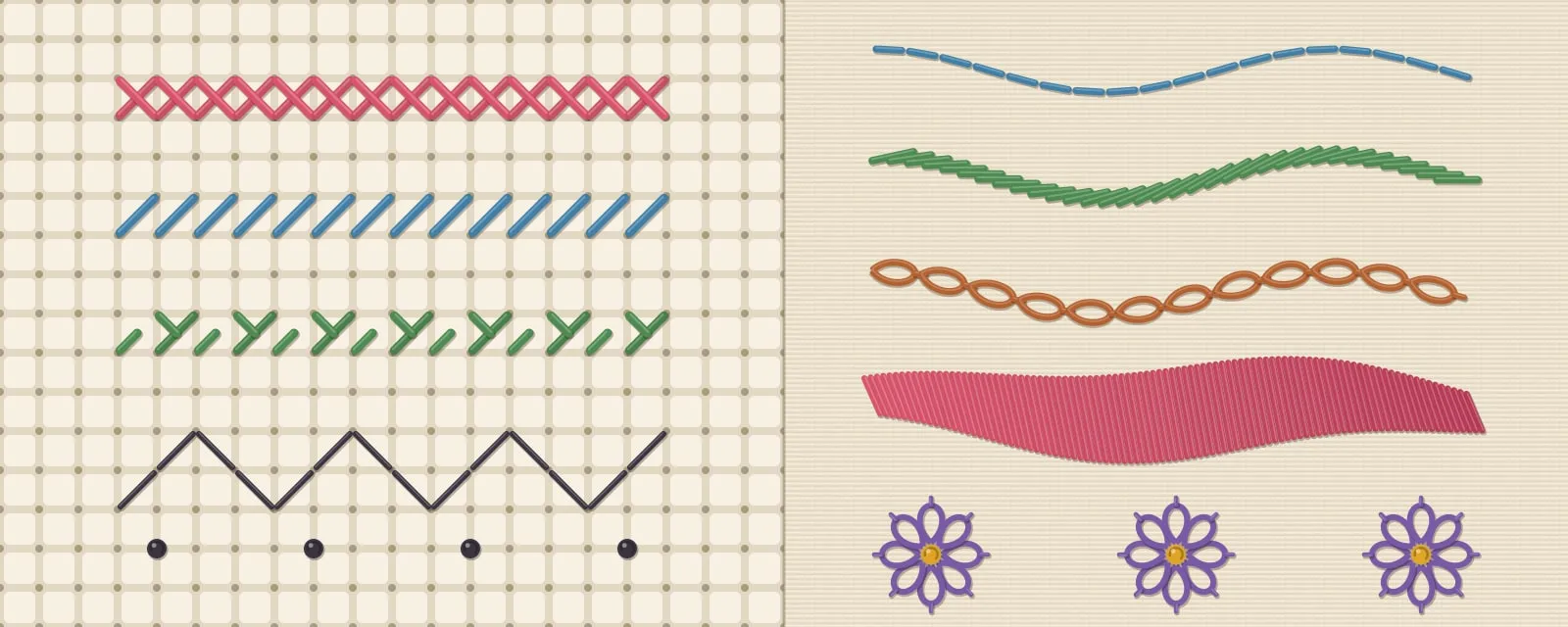
Lines are worked in backstitch or stem stitch, thicker lines in chain stitch. Satin stitch fills larger areas, lazy daisy makes petals and French knots make dots. Backstitch and the French knot belong to both crafts, so you’ll meet them whichever you pick.
Do they need different fabric, needles and thread?
You can use the same thread: ordinary six-strand floss works for both, so your stash won’t go to waste. Fabric and needles are another story, and the difference is easy to see.
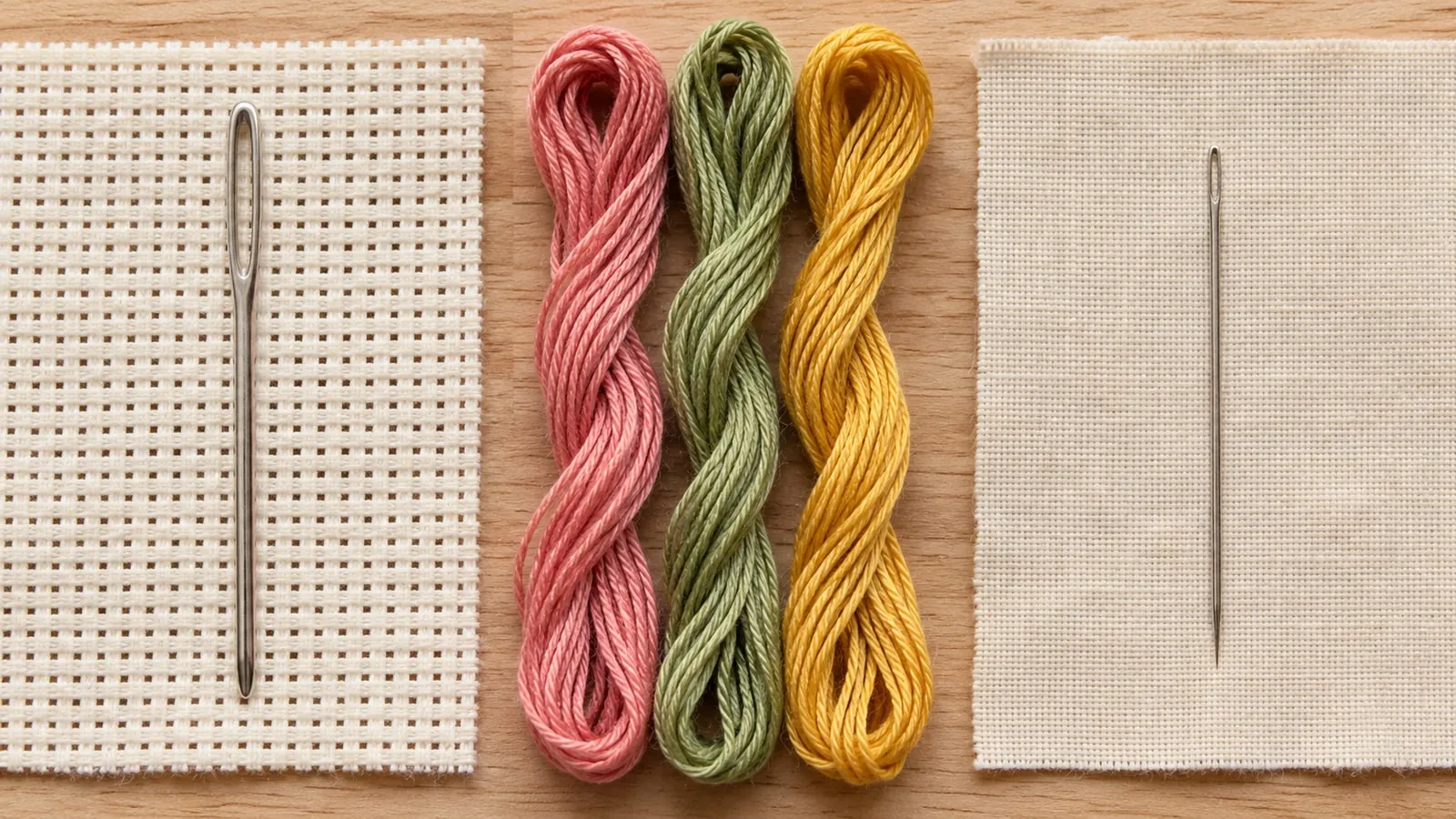
Cross stitch is done on Aida, a fabric with ready-made squares and holes at the corners. For a first project take Aida 14, and if you want to understand the numbers, read Which Aida count to choose for cross-stitch. Linen and evenweave are fussier: there you usually stitch over 2 fabric threads, and 28-count linen over 2 comes out the same size as Aida 14.
Surface embroidery needs tightly woven cotton or plain-weave linen. On Aida it struggles, because the needle keeps landing in the ready-made holes.
A tapestry needle for cross stitch has a blunt tip: it pushes the threads apart and slips into the hole. The sizes are easy to remember: 22 for Aida 11, 24 for Aida 14, 26 for Aida 16 and 18. Surface embroidery needs a sharp needle, since it has to pierce the fabric. The thicker the thread, the bigger the needle: roughly size 9–10 for 1–2 strands, 7–8 for 2–3, 5–6 for 4–6.
On Aida 14 you stitch with 2 strands and stop thinking about it. In surface embroidery you change the number of strands as you go: one for a fine outline, all six for a bold line. Colors and floss numbers are easy to find in the DMC color chart.
How does the design get onto the fabric?
In cross stitch it doesn’t: the design stays on paper or on a screen while you read the chart and count squares. For surface embroidery you first transfer it to the fabric with a water-soluble pen against the light, a heat-erasable pen or an iron-on transfer. There’s nothing to count, but the lines have to disappear afterwards, so test your pen on a scrap first.
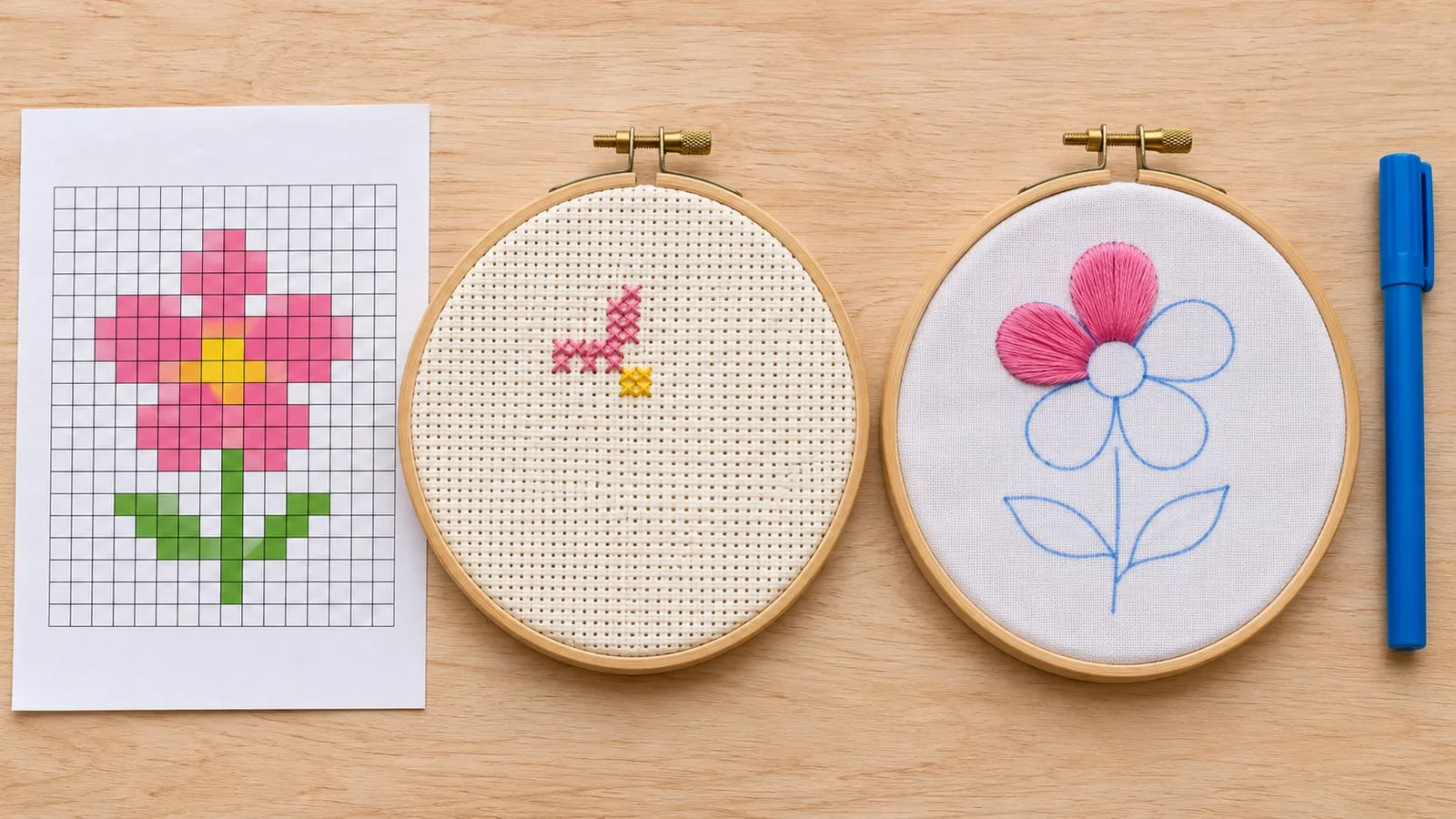
A cross-stitch chart works like a bitmap: one square, one color, one X. A nice consequence is that a photo can be converted into a chart automatically. Software shrinks it to the number of squares you want, picks the closest floss for each one, and you know right away how many stitches there will be and how many skeins to buy. That trick doesn’t work for surface embroidery, where the direction and length of every stitch are chosen by the person holding the needle.
Is cross stitch or embroidery easier?
Cross stitch is easier to start, and we won’t even argue about that. There’s one stitch, the grid shows you where the needle goes, and the result depends mostly on paying attention. In surface embroidery you have to learn several stitches and then learn to make them even with nothing to guide you. First projects usually come out a bit wonky, and that’s fine.
Then it gets more interesting. In a big cross-stitch piece you keep count for hours and change colors endlessly, and one square off shifts a whole section, which then has to be unpicked (nobody’s favorite activity). In surface embroidery a small wobble gets lost in the design, but a clean satin-stitch edge only comes with long practice.
Which takes longer?
Usually cross stitch, if you compare densely filled pieces of the same size, because you go over every square twice. Take a 100 × 100 chart on Aida 14. That’s a square of 7 × 7 in (18 × 18 cm) with up to 10,000 Xs, or 20,000 diagonals. At 150 stitches an hour that’s 67 hours; a beginner at 80 an hour will need 125. Enough for a couple of long TV series.
A fill like that takes about 9 skeins: one skein in 2 strands on Aida 14 covers roughly 1,100 stitches. For your own chart, the cross stitch calculator works it all out. You can’t estimate surface embroidery that way, since it depends on how much of the fabric you fill. An outline design of the same size goes much faster, while solid satin stitch can drag on as long as cross stitch.
Can you cross stitch an embroidery pattern?
Not directly. Cross stitch needs a grid and that pattern is all lines, so you first convert it to squares and the smooth outlines turn into stairs. The more stitches across and the finer the fabric, the less the stairs show. Fine lines are best left to backstitch on top of the crosses.
You can mix the two as much as you like. Backstitch outlines and French knots are already in many charts. Want cross stitch on plain fabric or clothing? That’s what waste canvas is for: you stitch through it, then pull its threads out one by one.
Where should a beginner start?
If you like having a plan and watching the picture grow square by square, start with cross stitch. Aida 14, a size 24 tapestry needle, floss in 2 strands and a small chart 40–60 stitches wide, which is about 3–4 in (7–11 cm). A small piece is something you can actually finish before the excitement fades, and not everyone manages that with a huge picture.
If you’d rather draw with a needle and count nothing, take tightly woven cotton, a hoop, a sharp needle and a simple design in backstitch, stem stitch and French knots.
It’s hard to go wrong here. You only learn once how to handle floss, secure a thread and keep your tension even, and the second craft comes more easily after that.
Try it
If cross stitch is calling and you have a favorite photo, upload it to the editor. Set “Width in stitches”, choose a fabric in the “Fabric” section and the size in centimeters appears next to it. Like the preview? Hit “Download PDF” to get the chart and the thread list. Which pictures work best is covered in Best photos and pictures for a cross-stitch pattern.
Try it with your own photo
Upload a photo — a pattern with DMC thread numbers is ready in a second.
Open the editorNew lessons by email
Now and then we send new lessons, ideas and patterns. No spam, unsubscribe at any time.